

Over 10 million C-Classes have been sold in the model’s 140-year history. It’s the car that built Mercedes in the mainstream, and now, for the first time, it’s going fully electric.
The sixth-generation C-Class had its world premiere in Seoul on April 21, 2026, and it’s not just a battery swap of the old model. It’s a clean-sheet reinvention; new platform, new architecture, new interior, and a design language that completely breaks from the polarising “jellybean” look Mercedes used on the EQE and EQS.
The question isn’t whether this is an impressive car. It clearly is. The question is: is it the right EV for you? We’ll get to that, but first, let’s go through everything you need to know.
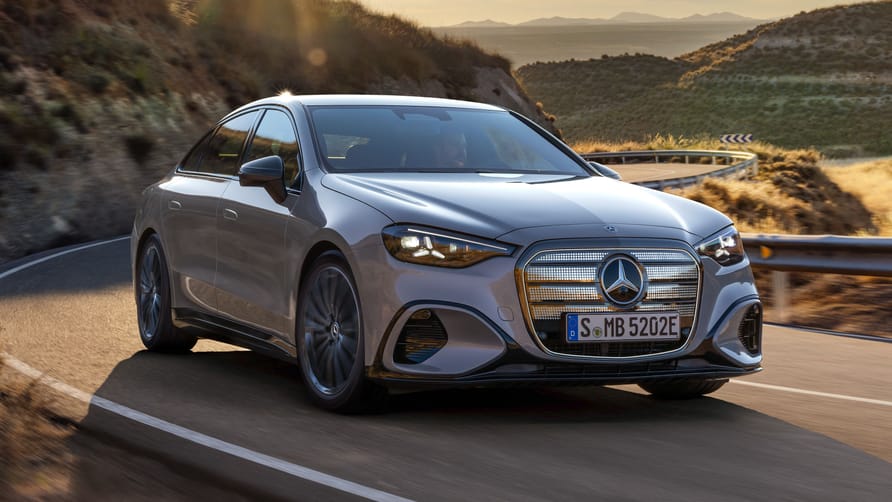
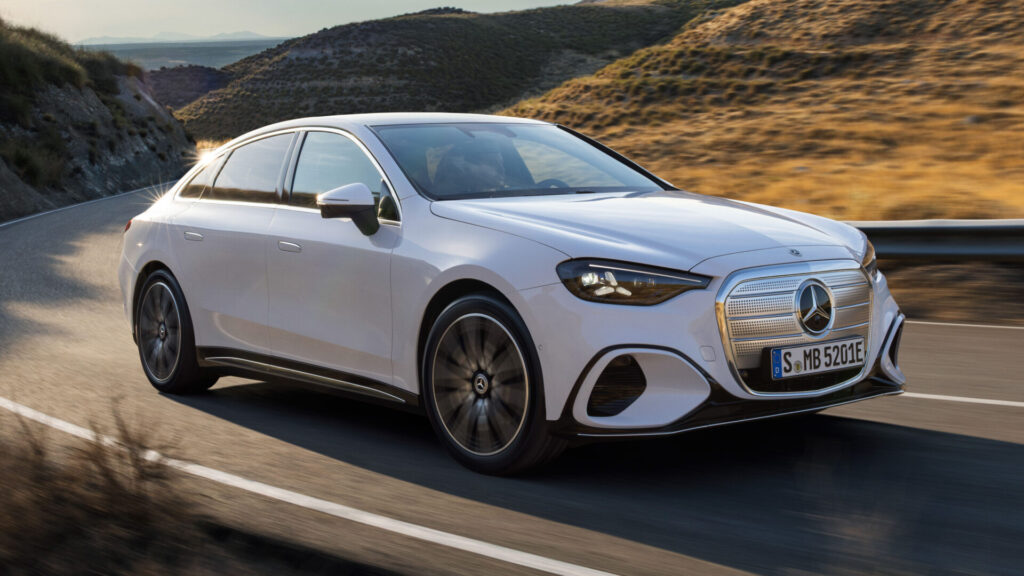
Der neue Mercedes-Benz C 400 4MATIC elektrisch. Energieverbrauch kombiniert: 18,6-14,2 kWh/100 km | CO₂-Emissionen kombiniert: 0 g/km | CO₂-Klasse: A [1] Exterieur: AMG Line; MANUFAKTUR opalithweiß metallic bright [1] Die Angaben sind vorläufig. Es liegen bislang weder bestätigte Werte von einer amtlich anerkannten Prüforganisation noch eine EG-Typgenehmigung noch eine Konformitätsbescheinigung mit amtlichen Werten vor. Abweichungen zwischen den Angaben und den amtlichen Werten sind möglich. The all-new Mercedes-Benz C 400 4MATIC electric. Energy consumption combined: 18,6-14,2 kWh/100 km | CO₂ emissions combined: 0 g/km | CO₂ class: A [1] Exterior: AMG Line; MANUFAKTUR opalithe white bright [1] The information is provisional. Neither confirmed values from an officially recognised testing organisation nor an EC type approval nor a certificate of conformity with official values are available to date. Deviations between the data and the official values are possible. 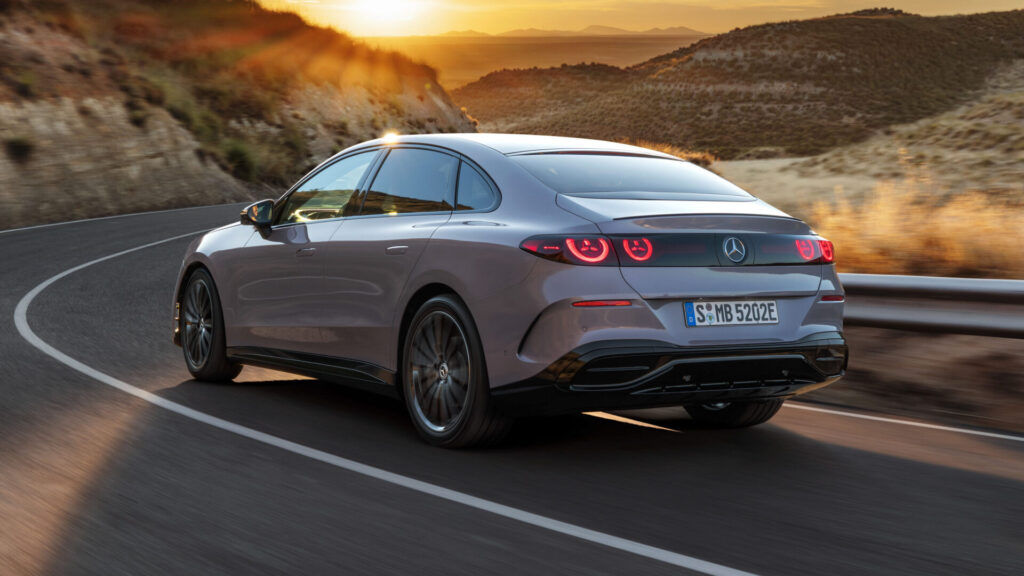
Der neue Mercedes-Benz C 400 4MATIC elektrisch. Mercedes-Benz C 400 4MATIC elektrisch | Energieverbrauch kombiniert: 18,5-14,1 kWh / 100 km | CO2-Emissionen kombiniert: 0 g/km | CO2-Klasse: A Exterieur: AMG Line Plus; lavender silver The all-new Mercedes-Benz C 400 4MATIC electric. Mercedes-Benz C 400 4MATIC electric | Combined energy consumption: 18.5–14.1 kWh/100 km | Combined CO₂ emissions: 0 g/km | CO₂ class: A Exterior: AMG Line Plus; lavender silver 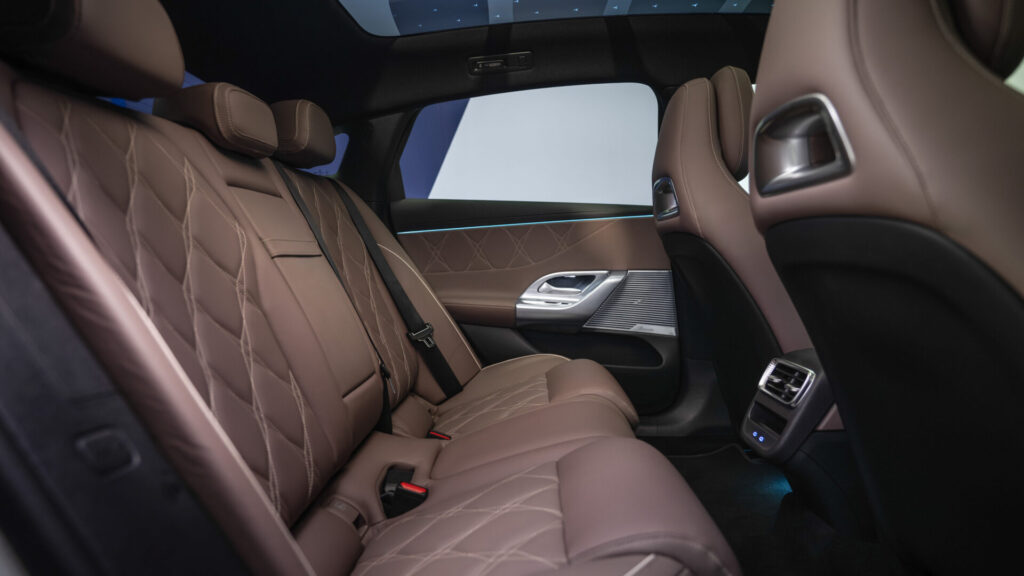
Der neue Mercedes-Benz C 400 4MATIC elektrisch. Energieverbrauch kombiniert: 18,6-14,2 kWh/100 km | CO₂-Emissionen kombiniert: 0 g/km | CO₂-Klasse: A [1] Exterieur: AMG Line; MANUFAKTUR opalithweiß metallic bright [1] Die Angaben sind vorläufig. Es liegen bislang weder bestätigte Werte von einer amtlich anerkannten Prüforganisation noch eine EG-Typgenehmigung noch eine Konformitätsbescheinigung mit amtlichen Werten vor. Abweichungen zwischen den Angaben und den amtlichen Werten sind möglich. The all-new Mercedes-Benz C 400 4MATIC electric. Energy consumption combined: 18,6-14,2 kWh/100 km | CO₂ emissions combined: 0 g/km | CO₂ class: A [1] Exterior: AMG Line; MANUFAKTUR opalithe white bright [1] The information is provisional. Neither confirmed values from an officially recognised testing organisation nor an EC type approval nor a certificate of conformity with official values are available to date. Deviations between the data and the official values are possible.
The Platform: Why “Built from Scratch” Actually Matters Here
The new C-Class sits on MBEA (Mercedes-Benz Electric Architecture) a fully dedicated EV platform shared with the new GLC Electric. This isn’t the MMA platform used by the smaller CLA (which can also accept petrol engines). MBEA is EV-only, and that distinction matters in three practical ways:
- Bigger battery. No need to package around an engine or gearbox means more room for cells.
- More front storage. The result is 101 litres of frunk space, large enough for a carry-on suitcase, something Mercedes’ previous EQ models were widely criticised for lacking.
- Better space efficiency. The floor is flatter, the wheelbase is longer, and there are fewer compromises in the cabin.
Full Model Lineup: All Five Variants Explained
Don’t just look at the launch model. Here’s the complete picture of what’s coming:
| Model | Battery | Drive | WLTP Range | Power |
| C 200 EQ | 64 kWh LFP | RWD | ~348 miles | TBC |
| C 250 EQ | 85 kWh | RWD | ~460 miles | TBC |
| C 300 4MATIC EQ | 85 kWh | AWD | ~447 miles | TBC |
| C 300+ EQ | 94 kWh | RWD | ~497 miles | ~335 bhp |
| C 400 4MATIC EQ (on sale now) | 94 kWh | AWD | ~472 miles | 482-489 bhp |
Our take:
The C 400 4MATIC is the only model available at launch, and frankly, it’s not the one most buyers should get. At around £55,000, you’re paying a premium for AWD and performance you may not need while giving up 25 miles of range versus the cheaper C 300+ EQ that’s coming in 2027. If you can wait, the rear-wheel-drive C 300+ EQ is almost certainly the sweet spot of the range.
The entry-level C 200 EQ is also worth watching; its 64 kWh LFP (lithium iron phosphate) battery is more environmentally friendly to produce and degrades more slowly, even with regular 100% charging. That’s a meaningful long-term ownership benefit that’s being underreported.
Range: Genuinely Class-Leading (With One Caveat)
The C 400 4MATIC offers up to 472 miles of WLTP range, while the rear-wheel-drive models are expected to push that to 497 miles. That comfortably beats the Tesla Model 3 Long Range’s ~390 miles WLTP.
The one honest caveat: the BMW i3 has a claimed range of up to 559 miles WLTP, so the C-Class doesn’t quite top the segment on pure numbers. But for the vast majority of drivers, including high-mileage company car users, 472 to 497 miles is more range than you’ll ever realistically need between charges.
A big reason for that range is aerodynamics. The C-Class achieves a drag coefficient of just 0.22, lower than the combustion-engine C-Class, and that fastback GT rear isn’t just a styling choice, it’s doing real aerodynamic work.
Performance figures are equally strong. The C 400 4MATIC accelerates from standstill to 62 mph in 3.9 seconds, with most of the power coming from the rear drive unit, which also features a two-speed transmission to improve both acceleration and motorway efficiency. Most EVs use a single-speed setup — this two-speed rear transmission is a genuinely rare and clever piece of engineering.
Charging: 330 kW and an 800-Volt Architecture
The C-Class uses an 800-volt architecture, the same high-voltage setup found in the Porsche Taycan, and supports peak charging of 330 kW at compatible ultra-rapid chargers.
In just 10 minutes, the electric C-Class can add up to 201 miles of WLTP range, and a 10% to 80% top-up takes as little as 22 minutes. At a 7 kW home wallbox, a full 0-100% charge takes approximately 15 hours.
One genuinely underreported feature:
The C-Class uses a multi-source heat pump that Mercedes claims heats the cabin twice as fast as a combustion engine during a 20-minute journey in cold weather (-7°C / 19°F). For anyone who’s sat freezing in an EV waiting for the heater to kick in, this is a big deal.
Design: Finally, a Mercedes EV That Looks Like a Mercedes
Mercedes took a lot of criticism for the blobby, jellybean styling of the EQE and EQS. The new C-Class takes a very different approach, a retro-homage grille reinterpreted for the LED era, with hundreds of illuminated points and a restrained, conservative body that lets the rear do the talking.
The tall illuminated grille references the large upright chrome grilles that were a trademark of halo Mercedes models throughout the latter half of the 20th century, a deliberate heritage play to differentiate from Tesla, BYD, and the BMW i3’s more futuristic face.
The grille features 942 LEDs across four slats, with animated welcome and farewell sequences when you lock or unlock the car. The rear uses what Mercedes calls an “athletic GT rear design” with broad, muscular flanks and a fastback silhouette, and the taillights carry a subtle three-pointed star motif.
Is the grille divisive? Yes. But in person, it works, and it looks far more special than the Polestar 2’s anonymity or the Tesla Model 3’s almost featureless face.
Suspension: The Cleverest Ride System in Any C-Class, Ever
Optional AIRMATIC air suspension is unavailable on the smaller CLA. It adjusts more intelligently than almost anything else on the market. The rear wheels also turn up to 4.5 degrees via rear-axle steering, shrinking the turning circle to just 11.2 metres, making a car that’s grown significantly in size feel surprisingly nimble in city traffic.
The standout feature is the crowd-sourced predictive damping. By constantly analysing data from Google Maps and communicating with other Mercedes vehicles, the suspension pre-adjusts the shock absorbers before your tyres hit a pothole or speed bump. If another C-Class hits a significant bump above a threshold, that location is stored in the cloud for 14 days, and your car will already know it’s coming before you arrive.
This isn’t a gimmick. For daily driving on imperfect roads, this could meaningfully improve ride quality in a way that no amount of conventional suspension tuning can achieve.
Interior: A 39-Inch Hyperscreen, AI Voice Control, and Vegan Leather
The optional MBUX Hyperscreen stretches 39.1 inches across the entire dashboard, bigger than most home televisions. A 10.3-inch driver cluster and 14-inch infotainment screen come as standard, with an optional 14-inch passenger screen available via the MBUX Superscreen upgrade.
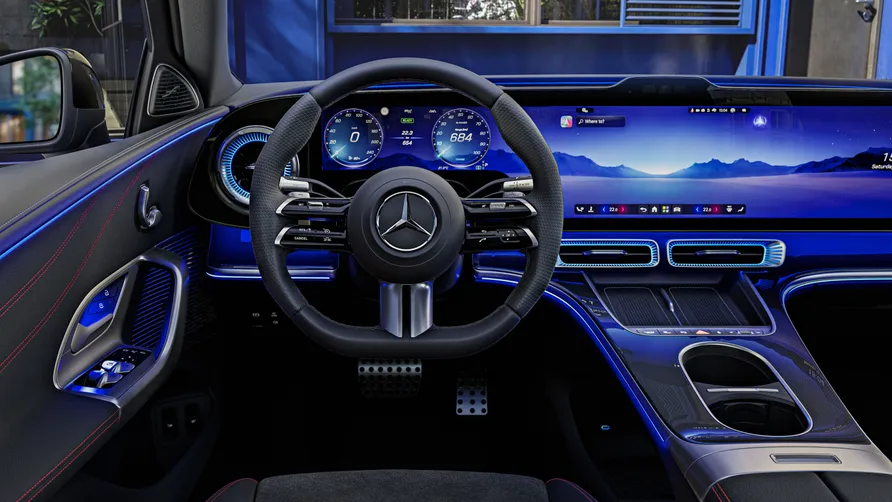
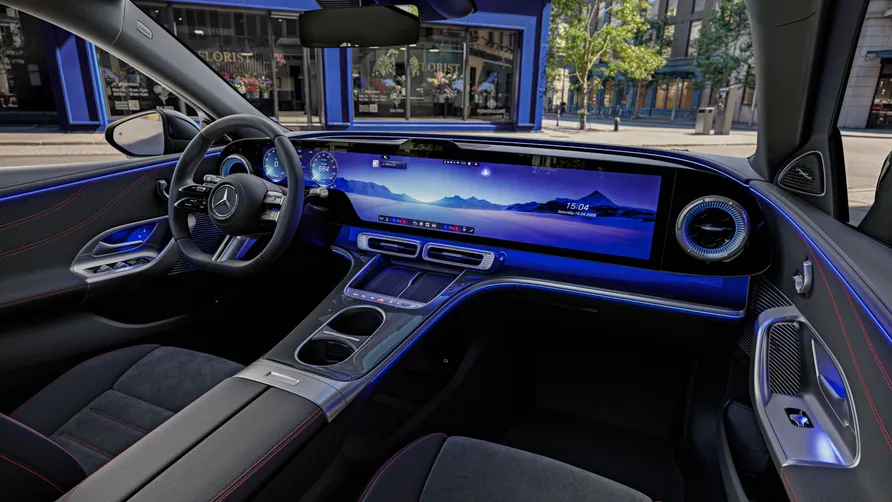
The AI operating system blends ChatGPT, Google Gemini, and Microsoft Bing into a voice assistant capable of handling complex, conversational commands, a significant step up from the “Hey Mercedes” system of previous generations.
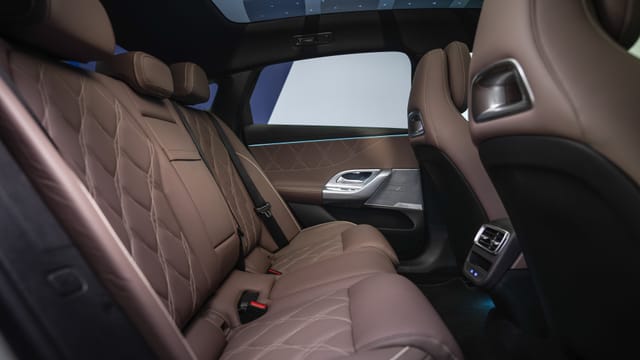
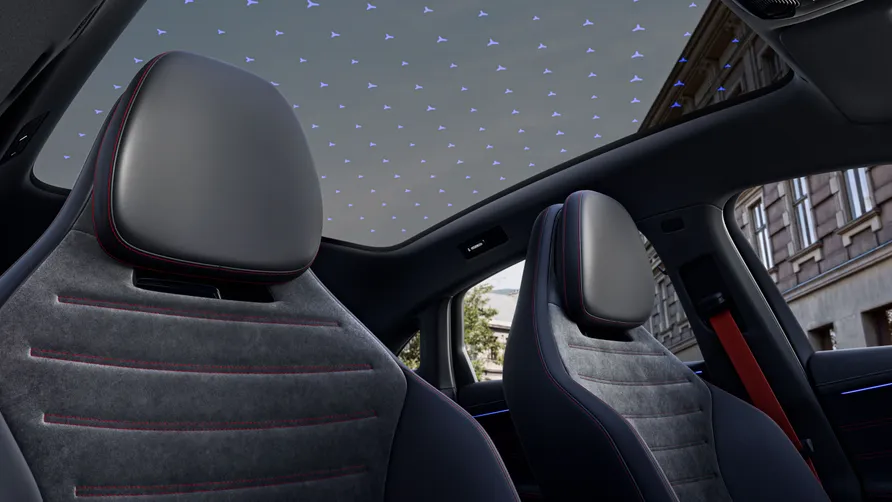
Other highlights: two wireless phone charging pads, a large floating centre console with generous understorage, huge door pockets, and interior colour options including Black, Beech Brown, and Macchiato Beige. A certified vegan interior is available alongside traditional Nappa leather.
The honest criticism:
Removing all physical climate controls is a real-world usability issue, not just a preference. The touch icons are small and require you to look away from the road. The colour pulse feedback blue for cooling, red for heating, is clever but still less instinctive than a physical dial.
Practicality: Bigger Boot, Massive Frunk, Estate Coming Later
- Boot: 470 litres (16.6 cubic feet) more than the current C-Class and the Polestar 2
- Frunk: 101 litres larger than the Tesla Model 3’s front storage, big enough for a carry-on suitcase
- Dimensions: ~130 mm longer, ~60 mm taller, 97 mm longer wheelbase than the outgoing model
- Estate (wagon) version confirmed for a later date, ideal for families
Rear headroom is the one genuine compromise. At just over 6 feet tall, headroom is tight, better than the CLA, but noticeably less than in a Tesla Model 3. If rear passenger space is a priority, factor that in.
Price & On-Sale Date
The C 400 4MATIC is expected to arrive in UK showrooms in late 2026 at around £55,000. The rear-wheel-drive, longer-range models are expected to follow in early 2027 and could bring the entry price down to around £45,000.
For US buyers, the electric C-Class is expected in early 2027, with prices starting around $55,000. Production is underway in Kecskemét, Hungary, with Europe receiving the car first.
Who Should Buy the 2026 Mercedes C-Class Electric?
This is the section most car articles skip. Here’s our honest breakdown:
Buy the C 400 4MATIC if…
You want the car now, love performance, and the extra £10,000 over the future C 300+ EQ doesn’t concern you. It’s fast, well-equipped, and the only model available at launch. If you cover high motorway miles and want the prestige of being an early adopter, this is your car.
Wait for the C 300+ EQ if…
You’re a rational buyer. More range, lower price, and RWD mean better efficiency. This will almost certainly be the best value variant in the range when it arrives in 2027. The only reason not to wait is if you need a car right now.
Consider the C 200 EQ if…
You mostly drive in urban or short-distance settings and care about long-term battery health. The LFP chemistry is more forgiving with regular 100% charging, and a lower entry price will make this the fleet and company car choice.
Look elsewhere if…
You need maximum rear headroom, want the absolute lowest price in the segment (the Tesla Model 3 starts considerably cheaper), or you can’t wait until 2027 for the full range to arrive.
2026 Mercedes C-Class Electric vs Tesla Model 3 vs BMW i3
| Feature | Mercedes C-Class EV | Tesla Model 3 LR | BMW i3 |
| Top WLTP range | 497 miles | ~390 miles | ~559 miles |
| Peak charging | 330 kW | 250 kW | Faster than C-Class |
| 0-62 mph (top model) | 3.9 sec | 3.3 sec (Performance) | TBC |
| Frunk | 101 L | ~88 L | TBC |
| Air suspension | Available (optional) | Not available | TBC |
| Drag coefficient | 0.22 Cd | 0.208 Cd | TBC |
| Rear-axle steering | Available | Not available | TBC |
| Heat pump | Yes (multi-source) | Yes | TBC |
| UK start price | ~£55,000 | From ~£40,000 | TBC |
| US start price | ~$55,000 | From ~$40,000 | TBC |
Pros and Cons: Our Honest Verdict
What we love
- Best-in-class range across most variants
- 330 kW ultra-rapid charging on 800V architecture
- Predictive crowd-sourced suspension is genuinely clever
- Frunk is finally practical and large (101 L)
- Heritage-inspired design that feels premium without being bland
- Rear-axle steering adds real-world agility
- A multi-source heat pump heats the cabin twice as fast in cold weather
What gives us pause
- At £55,000, you’re paying a launch premium; better value variants arrive in 2027
- No physical climate controls
- Rear headroom is tight for tall passengers
- The passenger screen can distract the driver
- The BMW i3 will likely offer more range and faster charging
Frequently Asked Questions
The C 400 4MATIC launches in Europe in late 2026. Additional variants follow in early 2027. The US market launch is expected in early 2027.
The launch model (C 400 4MATIC) offers up to 472-473 miles WLTP. The later rear-wheel-drive C 300+ EQ is expected to reach close to 497 miles WLTP.
It supports 330 kW peak charging via its 800-volt architecture, adding up to 201 miles of range in just 10 minutes, or 10% to 80% in around 22 minutes.
UK pricing starts at around £55,000 for the C 400 4MATIC. US pricing is expected to start around $55,000 when it arrives in early 2027.
It offers significantly more range, faster charging, a larger frunk, optional air suspension, and rear-axle steering. The Tesla Model 3 is cheaper and lighter. For buyers who prioritise luxury and technology, the C-Class wins. For pure value, Tesla still leads.
Yes. The fuel-powered W206 C-Class continues alongside the new electric model, starting from around £46,000 in the UK, with petrol, diesel, and plug-in hybrid options.
Yes,101 litres, large enough for a carry-on suitcase. It’s opened by pressing the Mercedes badge on the bonnet.
In our view, the C 300+ EQ arriving in early 2027 will be the sweet spot: up to 497 miles of WLTP range, rear-wheel drive for efficiency, and an expected price around £45,000.
Discover more from Autochat360
Subscribe to get the latest posts sent to your email.